Set Yourself Up for Success in Your Counseling Career
At The University of Scranton, the Clinical Rehabilitation Counseling program is geared to better prepare students to manage the challenges that come in a professional setting, including hands-on learning and access to dedicated, passionate faculty who want to see you succeed.
Our mission is to prepare students for careers in a variety of counseling settings, with the primary goal of acquiring and applying the specialized knowledge, skills, attitudes and values needed to collaborate with people who have disabilities to achieve their personal, social, psychological, and vocational goals.
What Makes Us Unique?
An environment built for education. Our Clinical Rehabilitation Counseling graduate program is now available fully online or hybrid for Fall 2026.
CACREP Accredited. One of only five Council for Accreditation of Counseling and Related Educational Programs (CACREP) programs in the Northeast.
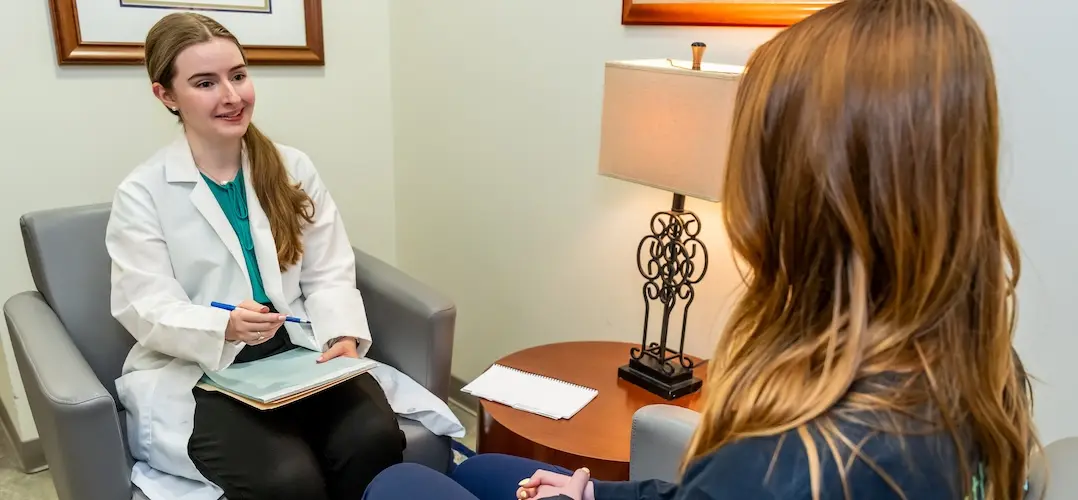
The David W. Hall Counselor Training Center provides students with state-of-the-art technology, such as video capture, that enables counseling sessions to be monitored and evaluated by hands-on supervisors. The center emphasizes experiential learning, allowing students to grow in a place where theory and practice intersect.
Rehabilitation Services Administration (RSA) scholarships help cover tuition for students in the Master of Science in Clinical Rehabilitation Counseling program. Eligible students may receive funding covering approximately 50–75% of tuition per term (excluding internship credits). Applicants must be U.S. citizens, enrolled in the program full time (6–12 credits per semester), in good academic standing, and have exhausted other tuition support options.
RSA scholarships include a service commitment. Recipients agree to work in the field of rehabilitation counseling in a qualifying agency after graduation. Scholarships are competitive, limited in number, and applications must be submitted by July 15 for full consideration.
The contents of this website were developed under grant H129B250024 from the U.S. Department of Education (OSERS). The Department does not mandate or prescribe practices, models, or other activities described or discussed in this document. The contents of this website may contain examples of, adaptations of, and links to resources created and maintained by another public or private organization. The Department does not control or guarantee the accuracy, relevance, timeliness, or completeness of this outside information. The content of this website does not necessarily represent the policy of the Department. This publication is not intended to represent the views or policy of or be an endorsement of any views expressed, or materials provided by any Federal agency (EDGAR 75.620).
US News & World Report ranks The University of Scranton’s Rehabilitation Counseling Program 49th of all programs in the nation.
Students graduating from the program are able to sit for the Certified Rehabilitation Counselor Examination which leads to the Certified Rehabilitation Counselor (CRC) credential and the National Counselor Exam which leads to the National Certified Counselor (NCC) credential - both of which are a step towards becoming a Licensed Professional Counselor (LPC) in most states.
Advance Your Counseling Career
Are you looking to advance your counseling career with the specialized knowledge, skills and values that will effectively assist and support individuals with disabilities throughout the rehabilitation process? The Clinical Rehabilitation Counseling program can help by creating an environment that encourages a commitment to life-long learning, critical thinking, resource development, creative problem solving, and the development of a professional network.
Earning an MS in Clinical Rehabilitation Counseling prepares rehabilitation counselors and related rehabilitation professionals for opportunities and advancement in counseling-related positions in public and private rehabilitation agencies, organizations and systems.
Career Outlook
Rehabilitation counselors help people with physical, mental, developmental, or emotional disabilities live independently. They work with clients to overcome or manage the personal, social, or psychological effects of disabilities on employment and/or independent living.
The Bureau of Labor Statistics indicates that employment for rehabilitation counselors will continue to increase over the next decade at a steady rate.
The Clinical Rehabilitation Counseling program is a 60-credit curriculum leading to the Master of Science degree and fulfills all the educational requirements for licensure as a professional counselor in most states including the state of Pennsylvania.
The curriculum is divided into two categories; Foundations of Professional Counseling (36 credits), and Rehabilitation Counseling courses (21 credits), plus one 3 credit elective.
Enhance knowledge of rehabilitation and counseling concepts and practices
Develop counseling skills necessary for functioning in mental/behavioral health and rehabilitation settings
Increase awareness and sensitivity to overall health related to quality of life outcomes
Prepare for certification as a rehabilitation counselor, national certified counselor and licensure as a professional counselor in most states
Improve your employability in entry-level or advanced clinical positions in community mental/behavioral health and rehabilitation settings
Admission Requirements
Program Directors review applications and pay particular attention to each applicant’s ability to address program specific professional goals and professional identity in the personal statements.
Personal interviews with program faculty members prior to acceptance are required. All interviews are scheduled by program faculty shortly after the application deadline.
Detailed requirements are listed on the Admissions page.
Financial aid options are available to help you pay for your education. A personal financial aid counselor will assist you in identifying and taking full advantage of all opportunities.
Faculty who work with the MS in Clinical Rehabilitation Program are accomplished educators and scholars currently engaged in research and scholarly work who help students reach new heights in the field through one-on-one mentorship and guidance.
Not only are they highly educated, but they also possess practical experience in the counseling field, as well as related careers.
How to Become a Psychiatric Nurse Practitioner: Your Guide to Making a Difference
Discover how to become a nurse practitioner, from earning your graduate degree to obtaining certification and licensure. Learn the steps, career benefits, and opportunities to make a lasting impact on patient care.
Support Resources for University of Scranton Online Students
Explore The University of Scranton support services for online graduate students -- including academic advising, writing help, virtual library resources, and tech support.
What is Clinical Rehabilitation Counseling? Understanding the Role, Responsibilities and Rewards
Discover the rewarding field of clinical rehabilitation counseling, where professionals empower individuals with disabilities to achieve independence and career success.